

Nearly 73% of employers said they planned to hire freshers in the first half of 2026, according to the TeamLease EdTech Career Outlook Report, and that single number sets up everything else about campus hiring in India this year. It is up three points from the previous half-year. And yet, when Unstop surveyed students around the same time, 84% of undergraduates were still unplaced despite all that hiring intent.
Both things are true at once. That gap, between employers who want freshers and freshers who can’t find the offer, is the real story of campus hiring statistics in India for 2026. Demand is back. Access is not evenly shared. This piece pulls the numbers together, and every figure links to a source you can open and check yourself.
Fresher hiring intent is strong, and uneven by sector
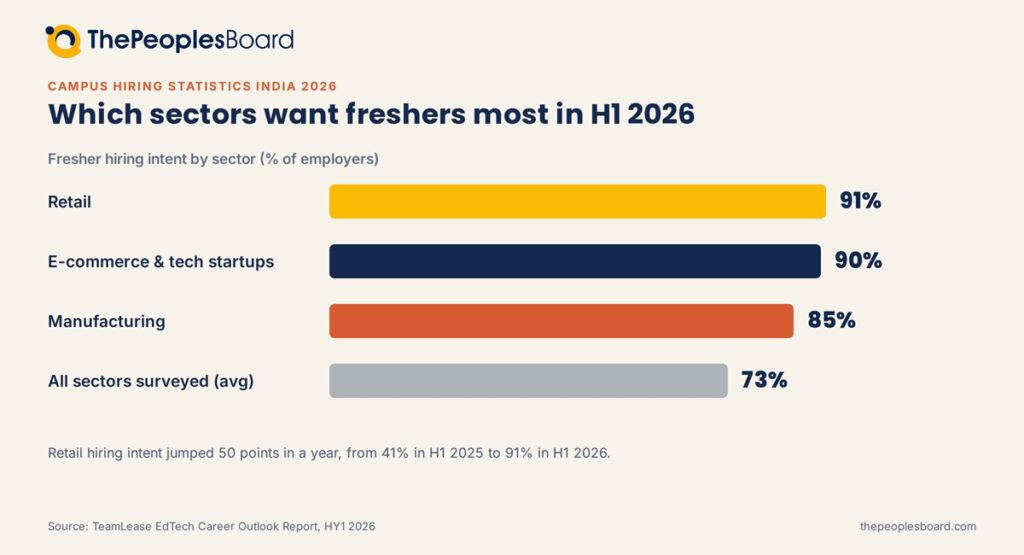
The TeamLease EdTech survey of 1,051 employers, run between November 2025 and January 2026, put fresher hiring intent at 73% for January to June 2026. Retail led at 91%, followed by e-commerce and technology start-ups at 90%, and manufacturing at 85%.
What I found more telling was the momentum inside those sectors. Retail hiring intent jumped 50 points in a year, from 41% in H1 2025 to 91% in H1 2026. Travel rose 51 points, from 26% to 77%. Power and energy climbed 50 points, from 22% to 72%. These are not gentle upticks. They are sectors switching fresher hiring back on after a cautious couple of years.
The platform data backs this up. Naukri’s JobSpeak index for January 2026 showed overall fresher hiring up 8% year on year, with non-IT sectors doing the heavy lifting and the IT sector staying flat for the month. And on the employer side, the Unstop Talent Report 2026, built on 37,000-plus students and 500-plus HR leaders, found 87.8% of companies actively recruiting and 90% of employers holding or increasing their hiring budgets for 2026.
So the budgets are there. The intent is there. The catch, as we will see, is that hiring is getting more selective rather than slowing down.
Package trends: Expectations are outrunning offers
This is where the mood check happens. Freshers expect more than the market is paying, and the gap is measurable.
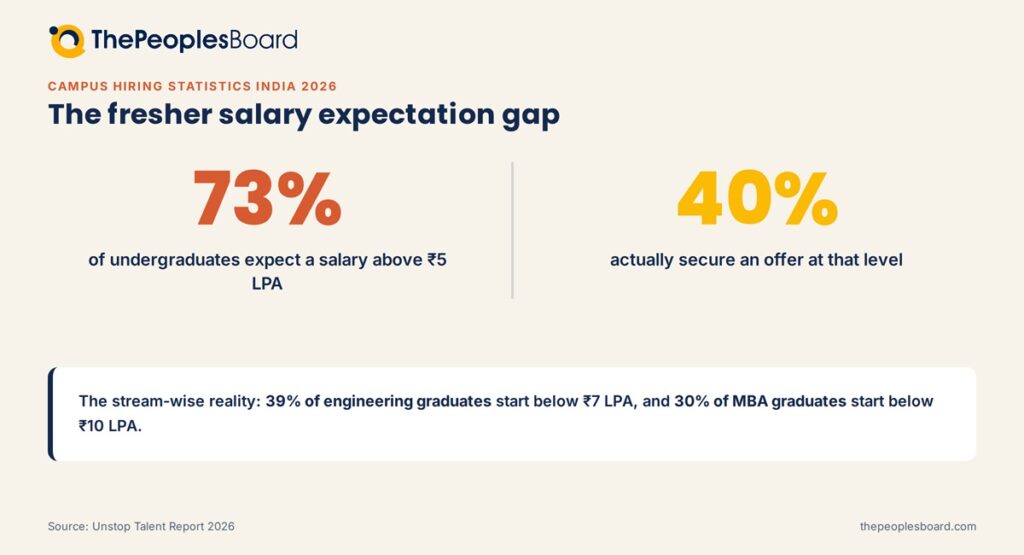
The Unstop data is blunt about it. 73% of undergraduates expect a salary above ₹5 lakh per annum, but only 40% actually secure an offer at that level. Break it down by stream and the old degree premium looks thinner than it used to: 39% of engineering graduates start below ₹7 LPA, and 30% of MBA graduates start below ₹10 LPA.
The longer trend is the same story told slowly. Deloitte India’s Campus Workforce Trends Report 2025 found campus compensation has rebounded over five years, but at a modest 3.11% compound annual growth rate across all degrees, with MBA graduates seeing the slowest growth at just 1.62%. In other words, packages are creeping up, not leaping, and the MBA is no longer the automatic pay multiplier it once was.
The one clear exception is specialised skill. Freshers who can actually demonstrate AI, machine learning, data, or cloud ability are pulling away from the pack on pay. The degree gets you into the room now. The skill sets the number.
Which colleges companies actually hire from
The shift I think matters most for anyone running early-career hiring in India is also the one the headline numbers tend to hide.
For years, campus hiring meant a familiar loop of tier-1 institutes: the IITs, NITs, top IIMs, and a handful of brand-name private universities. That is no longer where the volume sits. Mercer’s assessment team describes a clear expansion beyond traditional tier-1 institutions, with organisations now actively engaging tier-2 and tier-3 campuses as part of long-term workforce planning. TeamLease reports the same move, with recruiters building pipelines through universities, engineering colleges, ITIs, and polytechnics in smaller cities, often paired with apprenticeships and work-integrated learning.
The logic is practical, not charitable. Offer-to-join conversion tends to be higher outside the metros, where a strong package means more and candidates are less likely to be juggling five competing offers. Business is moving into tier-2 and tier-3 India, so the hiring follows. And remote-friendly early-career work has loosened the old geographic lock on talent.
I want to be honest about the data here, because it is where campus reporting gets loose. There is no single credible national figure I could open and verify that cleanly measures the tier-2/3 shift in percentage terms, so I am not going to invent one. What is well established, across the assessment firms and staffing companies that actually run these drives, is that the shift is real and treated as permanent. It also lines up with the India Skills Report 2026, which found the highest employability now sits in Uttar Pradesh, Maharashtra, and Karnataka, and that women’s employability is rising fastest in tier-2 and tier-3 cities.
Policy is nudging the same way. The National Education Policy 2020 pushed internships, credit-based learning, and employability into the higher-education system, and the apprenticeship route under the Apprentices Act, 1961 and the National Apprenticeship Promotion Scheme has become a genuine on-ramp for freshers from colleges that never used to feature on a campus calendar.
GCC versus IT services: The demand has quietly changed hands
If you want to understand where fresher demand is really heading, watch two very different engines.
The first is India’s Global Capability Centres. The Zinnov-Nasscom GCC Landscape in India 2026 report counts 2,117 GCCs employing 2.36 million professionals, with the ecosystem up 32% since FY2021 and India ranked as the world’s number one AI hiring market. These are not back offices anymore. They own global products and processes, and they have become the aspirational first employer for a lot of strong graduates.
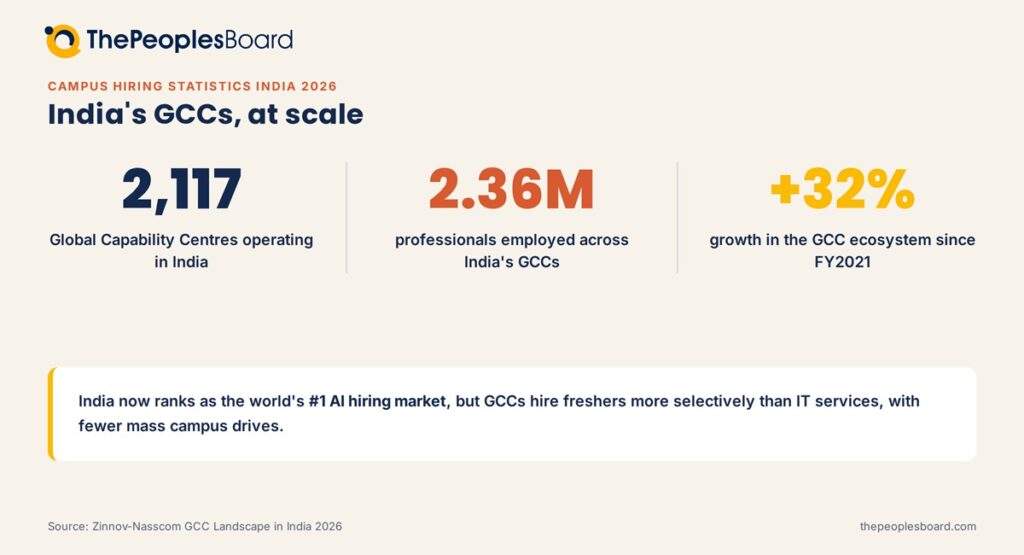
But GCC fresher hiring works differently from what most students expect. There are no drives sending out 10,000 offer letters. Nasscom’s own community analysis notes that GCC hiring has entered a more measured phase, with some volume and support roles seeing a 10-12% contraction in openings even as demand for high-value, AI-heavy roles stays strong. GCCs hire fewer freshers, more selectively, and pay more for the ones they take.
The second engine is IT services, and it is the one running the big campus drives. For FY26, TCS said it was confident of hiring around 40,000 freshers, Infosys planned over 20,000, and Wipro guided to 10,000-12,000. Those are still enormous absolute numbers. But the sector’s overall hiring has been choppy, and, as the Naukri JobSpeak data showed, IT stayed flat while non-IT sectors drove the January 2026 growth. The mass-recruiter model still exists. It is just no longer the only, or the most coveted, path off campus.
The skills freshers actually lack
Now the uncomfortable part, and the reason 73% intent can sit next to 84% unplaced without contradiction.
The India Skills Report 2026, the 13th edition, produced by Wheebox and ETS with CII, AICTE, AIU, and Taggd, put overall employability at 56.35%, up from 54.81% a year earlier. Read that the other way: even after a decade of skilling schemes, close to 44% of assessed youth are still not considered job-ready.
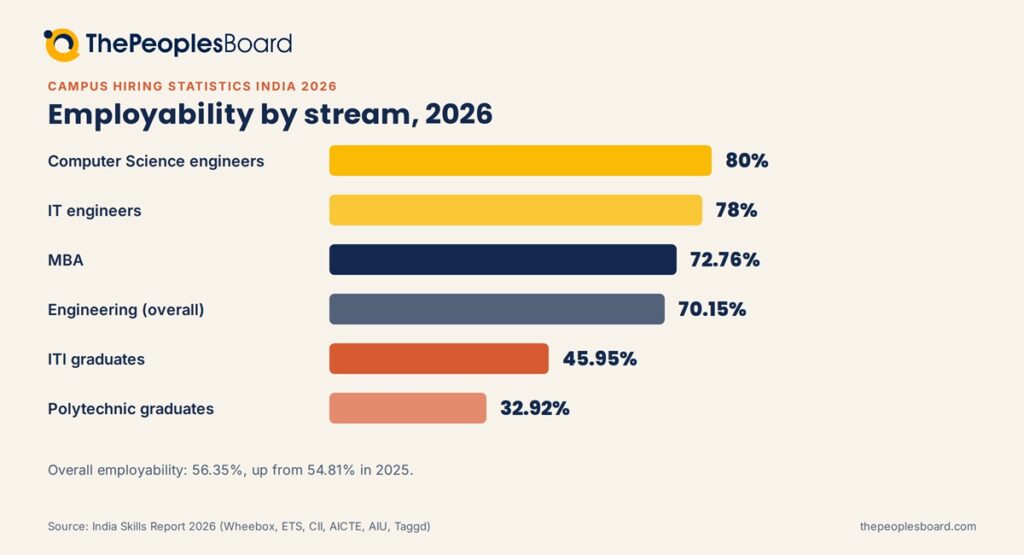
The stream-by-stream picture explains a lot about who gets hired:
- Engineering (BE/BTech) employability held strong at 70.15%, down slightly from 71.5% in 2025
- Computer Science engineers led at 80%, with IT engineers at 78%, driven by AI, data analytics, and automation roles
- MBA employability slipped to 72.76%, down from 78% the year before
- ITI graduates sat at 45.95% and polytechnic graduates at just 32.92%
That last gap is the issue nobody likes to name: the vocational streams meant to feed India’s factories and shop floors are the least job-ready of all. There is also a first in this data. Women’s employability rose to 54%, overtaking men at 51.5% for the first time in five years.
What are employers screening for instead of pedigree? Skills, and they are increasingly explicit about it. In the Unstop survey, 64% of HR leaders said they now define top talent by capabilities like AI/ML, data, cloud, and cybersecurity rather than by degree. The skills they named as most in demand were problem-solving at 49%, AI/ML at 39%, and emotional intelligence at 30%. India already holds about 16% of the world’s AI talent pool, and that is exactly the talent every serious employer is now fighting for on campus.
The through-line is simple. A degree opens the door. Proof of work, an internship, a real project, a portfolio, an apprenticeship, is what actually converts to an offer in 2026.
What this means if you hire freshers
If you run early-career hiring, the 2026 numbers point to a few honest moves. Widen the campus list beyond the metros, because the conversion and the loyalty are often better in tier-2 and tier-3 colleges. Screen for demonstrated skill, not just the college name or the CGPA, since that is what actually predicts who performs. Be realistic and transparent about pay, because the expectation-versus-offer gap is where your acceptances quietly leak. And treat internships and apprenticeships as your real pipeline, not a nice-to-have.
And if you are a fresher reading this: the degree is your entry ticket, nothing more. In a year when 73% of employers want to hire you, and most of your peers are still waiting for an offer, the thing that moves you to the front of the queue is proof that you can do the work.
FAQs
What percentage of employers are hiring freshers in India in 2026?
Around 73% of employers planned to hire freshers in the first half of 2026, per the TeamLease EdTech Career Outlook Report, up three points from the previous half-year. Separately, the Unstop Talent Report 2026 found 87.8% of companies actively recruiting and 90% holding or increasing hiring budgets.
What is the average fresher salary in India in 2026?
There is no single official average, and packages vary widely by stream and skill. What the data shows is a gap: 73% of undergraduates expect above ₹5 LPA, but only 40% secure it. Around 39% of engineering graduates and 30% of MBA graduates start below ₹7 LPA and ₹10 LPA respectively, and specialised AI or data skills command a clear premium.
Are companies hiring from tier-2 and tier-3 colleges now?
Yes. Assessment and staffing firms including Mercer and TeamLease report a clear, sustained expansion of campus hiring into tier-2 and tier-3 colleges, driven by higher offer-to-join conversion, business moving into smaller cities, and remote-friendly early-career work.
Which graduates are most employable in India?
Per the India Skills Report 2026, Computer Science engineers (80%) and IT engineers (78%) are most employable, followed by engineering overall at 70.15% and MBA at 72.76%. ITI (45.95%) and polytechnic (32.92%) graduates remain the least job-ready.
Are GCCs or IT services companies hiring more freshers?
IT services still run the largest campus drives, with TCS, Infosys, and Wipro together targeting tens of thousands of freshers in FY26. GCCs, now 2,117 centres employing 2.36 million people, hire fewer freshers but more selectively, often at higher packages and for higher-value roles.
Why are so many freshers unplaced if hiring intent is high?
Because hiring has become selective, not scarce. Employers want freshers who can demonstrate applied skills, so degree-only candidates face longer searches. The result is strong intent (73%) sitting alongside high unplaced rates (84% of undergraduates at the time of the Unstop survey).



